 Reviews


 Proudly American


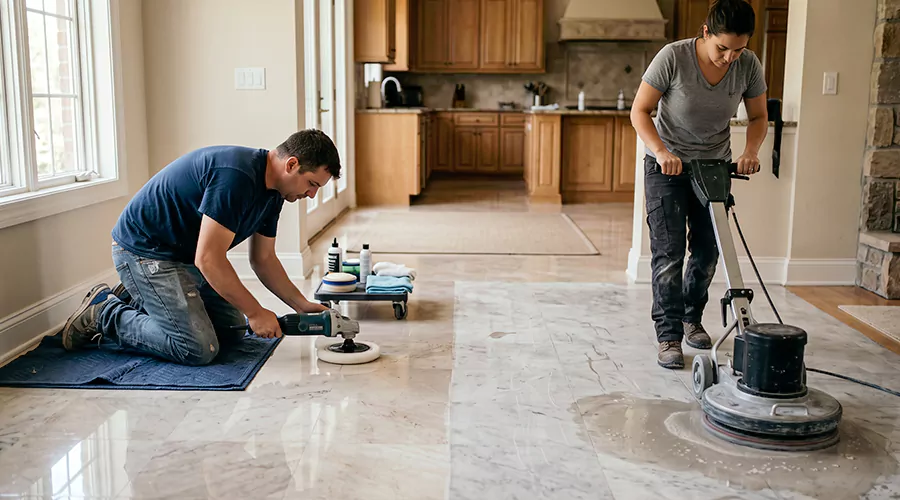
Marble polishing restores shine to a surface with light wear, while marble refinishing is a broader corrective process for etching, scratches, uneven wear, or deeper damage. Kitchen water damage repair may be needed when leaks or moisture have damaged cabinets, flooring, or other kitchen materials. Refinishing can include grinding or honing before polishing. The correct choice depends on how far the damage extends below the existing finish.
The terms are often used loosely, so the actual work matters more than the service label.
What is Marble Polishing?
Marble polishing is the finishing stage used to increase smoothness and reflectivity on stone that is already reasonably flat. Fine abrasives refine the surface, so polishing suits mild dullness better than major physical defects.
Typical polishing candidates include:
- General loss of shine
- Fine traffic scratches
- Light surface haze
- Small shallow etch marks
- Uneven gloss between nearby tiles
Marble floor polishing does not correct deep cracks or large height differences between tiles.
What is Marble Refinishing?
Marble refinishing removes deeper surface damage before the desired finish is rebuilt. It can include several abrasive stages depending on the condition of the floor. A badly etched floor may need honing, while lippage or deep scratches can require grinding first.
A typical process can include:
- Inspecting the marble.
- Identifying stains or physical damage.
- Repairing suitable cracks.
- Grinding when deeper correction is required.
- Honing the surface progressively.
- Polishing when gloss is wanted.
- Cleaning the completed surface.
- Sealing when appropriate.
Refinishing describes a wider scope than polishing alone.
How Do Polishing and Refinishing Compare?
The biggest difference is the depth of correction. Polishing works near the finished surface, while refinishing can remove enough material to correct more noticeable defects before the finish is rebuilt.
| Condition | Polishing | Refinishing |
|---|---|---|
| Mild dullness | Usually suitable | Usually unnecessary |
| Fine scratches | Often suitable | Sometimes |
| Light etching | Often suitable | Sometimes |
| Moderate scratches | Limited | Better choice |
| Widespread etching | Limited | Better choice |
| Tile lippage | No | Grinding may be required |
| Deep surface damage | No | Usually required |
Marble restoration is often used as a broader term for repair and refinishing work that goes beyond routine polishing.
What Role Does Honing Play?
Honing is an abrasive stage that creates a smooth surface with a matte or satin appearance. It can also remove etching and moderate scratches before the floor is polished to a higher shine.
A honed finish can be the final appearance if a lower-gloss surface is preferred. When gloss is wanted, finer polishing stages follow.
Deeper scratches and difficult etched areas may need refinishing or re-polishing rather than simple cleaning.
When is Polishing Alone Enough?
Polishing alone is usually enough when the floor is flat and the damage is shallow. If the surface still feels smooth but looks less reflective than protected areas, a polishing stage may restore the appearance without aggressive correction.
Use polishing when:
- Traffic has reduced the shine.
- Fine marks do not catch a fingernail.
- Tiles remain level.
- There are no deep pits.
- Etching is shallow and limited.
- The stone remains structurally sound.
When is Refinishing the Better Choice?
Refinishing becomes more appropriate when defects can be felt or seen clearly even after cleaning. Deep scratches cannot simply be made shiny because the damaged profile remains in the stone.
Signs that refinishing may be needed include:
- Scratches catch a fingernail.
- Etching covers broad areas.
- Traffic paths are visibly worn into the surface.
- Tile edges have noticeable height differences.
- Old polishing created inconsistent shine.
- Deep stains require separate correction.
- Small chips need repair before finishing.
- The surface has multiple previous repair marks.
Marble refinishing can restore a consistent surface when polishing alone would leave these defects visible.
Is Refinishing the Same as Grinding?
No. Grinding is the most aggressive correction stage and may be only one part of refinishing. It uses coarse diamond abrasives to flatten uneven areas or remove deeper damage.
A typical progression is:
- Grinding for deep defects or lippage
- Honing for scratches or etching
- Polishing for gloss
Not every floor needs all stages. Starting too aggressively removes more stone than necessary.
How Much Do Marble Restoration Projects Cost in 2026?
Current 2026 U.S. data places the average marble restoration project around $840, with many projects between about $200 and $2,500. Broader refinishing work costs more than a simple polish because it may require extra abrasive stages.
Paying for grinding when the floor only needs polishing adds unnecessary labor.
What Can You Check Yourself?
A clean-and-light test can show whether the floor needs polishing or deeper correction. Clean the marble with a pH-neutral stone cleaner and let it dry.
Then:
- Shine light across the floor at a low angle.
- Compare busy areas with protected sections.
- Run a fingertip over visible scratches.
- Check whether scratches catch a fingernail.
- Look for uneven tile edges.
- Mark dull patches that remain after cleaning.
Smooth dullness points toward polishing. Physical grooves or noticeable unevenness point toward refinishing.
When Should You Call a Professional?
Professional assessment is appropriate when you cannot tell whether a defect is staining or etching. Deep scratches or lippage also need care because aggressive abrasion permanently changes the stone.
Consider professional help when:
- Tile edges are uneven.
- Deep scratches cover several areas.
- Etching keeps returning after cleaning.
- Cracks or chips need repair.
- Previous resurfacing was uneven.
- The stone type is uncertain.
Marble floor restoration may require different abrasive steps across separate areas of the same room.
How Can You Avoid Unnecessary Refinishing?
Maintain the finish before wear becomes deep. Use a pH-neutral cleaner and remove abrasive grit regularly. Acidic cleaners can etch marble.
Helpful habits include:
- Place mats near entrances.
- Wipe acidic spills immediately.
- Use felt pads beneath furniture.
- Vacuum or dust mop regularly.
- Avoid abrasive household cleaners.
- Reassess dullness after proper cleaning.
Stone restoration becomes less invasive when damage is corrected before deep grinding is required.
Conclusion
Marble polishing and refinishing solve different levels of surface damage. Polishing restores reflectivity when wear is shallow, while refinishing can remove deeper scratches or widespread etching before the final finish is rebuilt. Start with the least aggressive process that solves the problem. If scratches catch a fingernail or tiles are uneven, professional assessment can determine whether honing or grinding is needed before polishing.
Frequently Asked Questions
Is polishing part of marble refinishing?
Yes. Polishing can be the final stage of a broader refinishing process when a glossy finish is desired.
Can polishing remove deep scratches?
No. Deep scratches usually require honing or another abrasive stage before polishing.
Does refinishing always make marble shiny?
No. Refinishing can end with a honed matte finish if high gloss is not desired.
Is grinding always required during refinishing?
No. Grinding is used for deeper damage or uneven tiles. Many floors need only honing followed by polishing.
Can marble be refinished more than once?
Yes, when enough stone thickness remains. The least aggressive process should be used each time.
Is sealing the same as polishing?
No. Sealing reduces liquid absorption, while polishing changes the smoothness and reflectivity of the stone surface.